moxibustion

Palpating a Path to the Ear: Ontake Moxibustion for Hearing Loss and Tinnitus

Palpating a Path to the Ear: Ontake Moxibustion for Hearing Loss and Tinnitus


In this post, I’ll describe a palpation-based Ontake routine I use when treating patients with hearing loss and tinnitus. If you make it to the end of this post, there’s a video there that shows the routine in action!

It is not a miracle cure, and it will not help every case. But in selected patients, especially where abnormal tissue findings are present around the neck, scalp, mastoid or ear, I have found it can produce surprisingly rapid changes—much faster than when I used needles alone in my Japanese acupuncture practice.

When I teach, I always use an analogy to explain what we’re doing. When you go to visit your best friend, you ring the doorbell. That sends information from the outside of the house to the inside, triggering movement. We can’t say that the doorbell opened the door. Acupuncture and moxibustion are the same. We send information from the outside of the body that triggers change. We can’t say that the treatment cures the person. Instead, it triggers the body to cure itself.

Over the better part of twenty-five years, I’ve developed a palpation and Ontake routine that helps us shape the information we want to present to the outside of the body, to help trigger those changes in the circulation of qi and blood to the ear. This routine is simple to learn, and readers can adapt it to their own protocols for patients presenting with these problems. Of course, the key is practice: learning to recognise the palpatory indicators and accumulating experience with what they mean. Palpate, treat what you find, then step back and let the body do the rest.

Learning to Read the Body

This approach has its roots in something that happened to me in Tokyo in 2000, at a Toyohari seminar, long before I’d developed Ontake at all (Toyohari is a meridian therapy style of Japanese acupuncture). A model in my study group complained of migraines, and one of our teachers—Akihiro Takai, then president of the Toyohari Association—palpated her scalp and asked her, without being told anything, whether the migraines were on the right: they were. This astounded the rest of us, but he guided our hands to the same spot so we could feel what he’d felt: the scalp was noticeably tighter on the right than the left. That was my initiation into palpation as an objective way of reading the body—not just confirming what a patient tells you, but finding things they haven’t told you at all.

A Finding Nobody Asked For

Maybe six or eight months after that Tokyo seminar, I had a patient—I’ll call him Tom, about thirty at the time—who came in without mentioning that he had headaches. As I was palpating his neck, something we do routinely in Toyohari, I noticed something odd: a puffy, spongy swelling around the right mastoid process. On a hunch, I asked him if he got headaches.

“Yeah,” he said. “I get migraines. On the right.”

At that point in my career, I hadn’t yet encountered Ontake, so I treated the area with a teishin, stroking gently over the abnormal tissue. I repeated this over two or three visits. Each time, the puffiness was less pronounced. By the third visit, it had all but resolved—the tissue felt normal again.

I didn’t see Tom again for years. When I finally did, one of the first things he told me was that he had never had a migraine again. As is so often the way with palpation, it revealed something he hadn’t mentioned and resolved something he hadn’t thought to address.

An Accidental Clue

As you might know, I was introduced to Ontake in 2009, and by 2019, I was teaching the Ontake Method in Brazil. The group was practising Bamboo Max—a whole-body Ontake sequence working the arms, legs, and back.

After the session, one student approached me and asked whether Bamboo Max was supposed to cure tinnitus. It isn’t—that’s not what I’d taught it for. But when I asked whether she’d had neck problems, she said yes, and that her neck was also feeling much better.

My guess was that Bamboo Max, by releasing abnormal tissue along the six yang channels—small intestine, triple burner and large intestine in the arms; stomach, gallbladder and bladder in the legs—was indirectly releasing the neck, since all six channels pass through it. And if the neck releases, blood can move more freely into the ears. As you’ll see below, I already had an Ontake routine for ear problems. This was something else: a clue that a whole-body sequence, never designed with the ears in mind, could reach them anyway, by way of the neck.

The Three Circles

A year later, back in Brazil, I was demonstrating the ear routine described in my book Moxa in Motion. It’s two short paragraphs and describes palpating and treating three concentric circles worked at three different frequencies:

  1. An outer circle roughly following the gallbladder channel’s zigzag across the temple, tapped at 120 beats per minute
  2. A middle circle following the perimeter of the ear on the scalp, at the triple burner frequency of 152 beats per minute
  3. An inner circle on the auricle itself, back at the kidney frequency of 120 beats per minute

I asked for a volunteer, found some puffiness in his temple, and worked that side. When I finished, he surprised me by asking me to treat the other side as well.

I assumed he was just enjoying the Ontake—after all, it is very relaxing, but that wasn’t it. He had tinnitus in both ears, and the sounds in his right ear had stopped after the demo. Could I treat the left as well?

In my experience, treating tinnitus with needling can lead to improvement and resolution, but it takes months. An almost instantaneous result was, at that point, only the second time I’d seen anything like it. I treated the left side, and he reported the same: for the first time in a long while, he had no ringing in either ear. I wasn’t able to follow up with him afterwards, so I don’t know what the longer-term outcome was—but in the short term, it was a striking result.

This has been a recurring theme on my teaching tours. Ontake often seems to produce rapid changes with tinnitus. What I hadn’t seen—until this year—was whether it could do the same for hearing loss.

Josh: Hearing Loss Since Childhood

Fortunately, we filmed this demonstration, so you can see in detail how I approached this case. As a child of seven or eight, Josh had what may have been skull-base osteomyelitis (he’s not sure of the diagnosis and described it as “bone-eating disease”). He underwent surgery to remove infected tissue from his occiput and the area behind his ear. In the years since, he’s had hearing loss in both ears, more pronounced on the left.

I started by palpating what we call, in Toyohari, the naso region, the front and back of the neck. On the left, it was markedly kyo—deficient, dry, inelastic, as though no qi was moving through it at all. I began treating the healthier right side first, tapping with Ontake and addressing what I found there.

Working up into his scalp, I found abnormal tissue on both sides: a painful area on the right, and—behind both ears—scars that were still active. An active scar, in this context, feels different from a healed one. A healed scar feels essentially two-dimensional under the fingers—flat, with no depth to it. An active scar has depth: a three-dimensional, worm-like quality, as though there’s a thin structure running just beneath the skin. In Josh’s case, each scar was about 1.5cm, flush with the skin surface but extending downward—like a thin horizontal worm beneath the skin.

I think of an active scar as a lock gate across a canal. Qi and blood pool on one side—that side feels excess, or jitsu—while the other side runs low, feeling deficient, or kyo. We need to balance the water levels on either side of the lock. Treating a scar with Ontake means applying draining techniques where there’s excess and supplementing techniques where there’s deficiency, to rebalance qi and blood across it. That’s what I did on both of Josh’s scars.

Interestingly, I was using a metronome, positioned by his left ear, throughout the treatment. By the time I’d finished working on his neck, he told me the metronome had already grown clearer. His left ear normally couldn’t pick up low-volume sounds at all—but as I worked, the metronome’s volume seemed, in his perception, to grow. By the time I had finished both sides, he reported that the hearing in his left ear felt normal. This perceived improvement lasted for a couple of months after the session: he felt he had normal hearing again.

That kind of response speed is not what we expect with long-standing hearing loss. As I say in the video, it’s “impossible!” But it did, making me even more in awe of the power of moxibustion to treat chronic conditions.

Conclusion

I’m not proposing I’ve found a cure for tinnitus or hearing loss with Ontake. What I think I’ve developed is an approach—a palpation and treatment routine—that can be useful in certain cases and that practitioners can adapt for patients presenting with these problems.

As I said at the start, we’re not curing the patient. We’re sending information from outside the body to the inside, the way a doorbell sends a signal from outside a house to whoever’s inside to hear it. We can’t say the doorbell opened the door. We can only say it caused something to happen.

Palpate. Treat what you find. Then step back and let the body do the rest.

Palpating a Path to the Ear: Ontake Moxibustion for Hearing Loss and Tinnitus Read More »
Manaka Made Simple: Read Chapter 1 Free


Manaka Made Simple
A practical guide to Dr Manaka’s system of Japanese acupuncture and moxibustion


If you found the article on Manaka System Acupuncture in Yin Yang useful, this book takes the ideas further: pattern selection, abdominal diagnosis, the Four Step Protocol, ion-pumping cords, dosage, and clinical application.

DOWNLOAD CHAPTER 1 TO MY DEVICE


VIEW CHAPTER 1 ONLINE

Loading Viewer...

DOWNLOAD CHAPTER 1 TO MY DEVICE

Ordering note
The book is available through international book distribution. Swiss readers can ask their local bookshop to order it using the ISBN, or use their preferred online retailer.

AMAZON


ISBN
1068381426

For bookshops, schools, course organisers, or bulk orders, view Sayoshi Books.
Trade discounts are 40% for orders of 5–9 copies, 45% for 10–19 copies, and 50% for orders of 20 copies or more.

Books are supplied on a prepaid basis and are printed and shipped locally.


Join the Ontake Method newsletter for updates on Manaka events, Japanese acupuncture and moxibustion books, articles, and resources..

Manaka Made Simple: Read Chapter 1 Free Read More »

Jôsetsu-hô for Abdominal Pain and Indigestion

If you’re not familiar with jôsetsu-hô, it’s a traditional Japanese moxibustion method that uses string measurement and palpation to locate highly effective moxa points. Rather than relying solely on fixed anatomical landmarks, practitioners use a proportional measuring system, using string or a measuring triangle, to guide treatment and locate the points.

This is really interesting. To give you an example, to treat headache, you wrap a piece of string around the head at the level of the forehead. Then you get that same length of string and put it round the neck at the level of the Adam’s apple and drape it backwards, so the ends meet at the posterior midline. The point for headache is at the ends of the string!

To give you more sense of how it works in practice, here’s an extract from Felip Caudet’s new book The Lost Art of Jôsetsu-Hô Moxibustion.

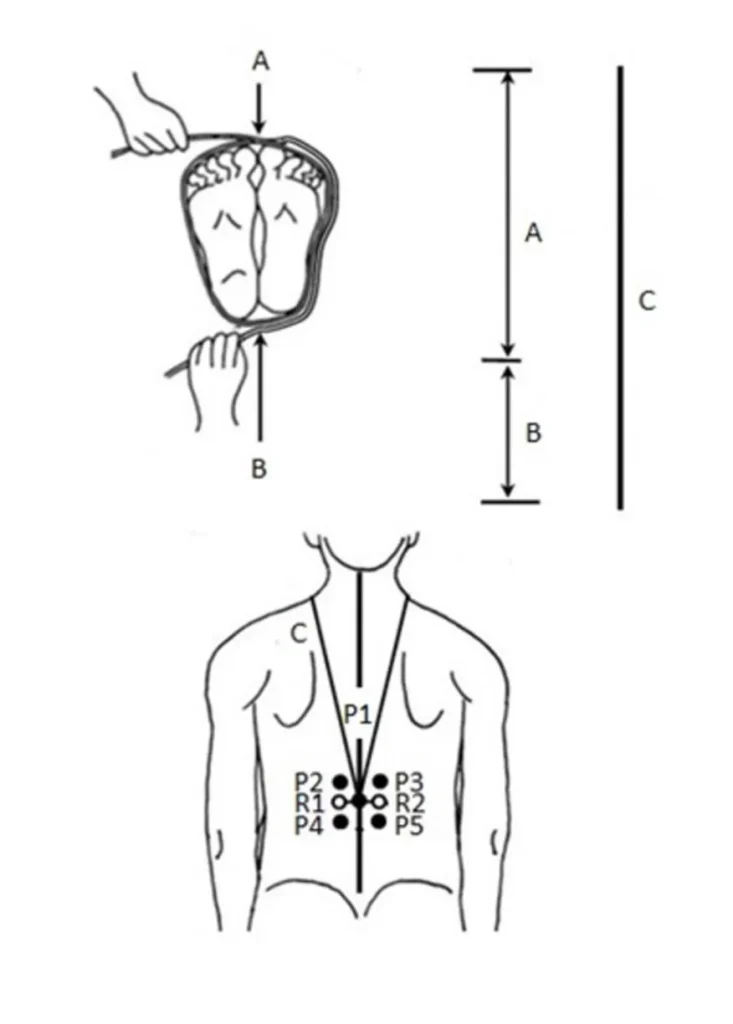
A quick word of explanation: Felip uses a shorthand to explain the steps. The first thing he does is to get a measurement, and he assigns a letter to it, like A or B. This measurement is often used to get a reference point and he calls those R1, R2 etc. Reference points are not used for treatment, just as navigation points to the treatment points.

Finally, the measurement or the reference point can be used to get the actual treatment points and he calls them P1, P2, P3 etc. It’s very simple once you start doing it and the illustrations are childishly simple. The jôsetsu-hô technique below is for abdominal pain. I think you’ll find it useful!

Two diagrams showing a jôsetsu-hô technique. The first shows string wrapped around the feet to get measurements A and B, which combine into C. The second shows how measurement C is used around the neck to locate point P1 on the back midline. R1 and R2 are marked 1 cun lateral to P1; P2 and P3 are 1 cun superior, and P4 and P5 are 1 cun inferior.
A five-point set for abdominal pain

Abdominal Pain

These five points can be used on all types of abdominal pathologies. In particular, they treat abdominal pain coming from the stomach, intestines, uterus, bladder, gall bladder or urethral tract. Applying the right number of cones is important, easily reaching 30 cones per point. In all cases, however, the dosage should be adapted to the patient’s condition, using fewer cones if they are weak and more if they are robust. Occasionally, abdominal pain and diarrhoea may occur during treatment, although both symptoms are considered benign.

Applications
Non-recurring, acute abdominal pain.

Method

  1. Put the patient’s feet together and wrap the string around the perimeter of both feet: (A).
  2. Wrap the string an extra half-turn around the perimeter of the feet (B). This gives you a perimeter and a half: (C).
  3. Loop the string around the neck at the superior margin of the laryngeal prominence, with the ends of measurement (C) meeting inferiorly on the posterior midline. P1 is located on the midline.
  4. To locate the remaining four points, measure 1 cun laterally on either side of P1 to get R1 and R2. From these two reference points, find P2 and P3, 1 cun superior, and P4 and P5, 1 cun inferior.

If you’d like to explore more of these elegant and practical techniques, The Lost Art of Jôsetsu-Hô Moxibustion is available now in paperback and Kindle, with a launch discount until 31 July:

📘 Buy on Amazon
📘 Buy on Amazon France
📘 Buy on Amazon Australia

BUY BOOKS AND MOXIBUSTION PRODUCTS IN THE ONTAKE SHOP

Please share this post with colleagues who love moxa. Let’s revive the lost art together.

CHECK OUT MORE TITLES ABOUT JAPANESE ACUPUNCTURE AND MOXIBUSTION AT SAYOSHI BOOKS

Jôsetsu-hô for Abdominal Pain and Indigestion Read More »

TRPs and a New Model for Understanding Moxibustion

Coming soon: The Moon over Matsushima Second Edition


First published in 2012, The Moon Over Matsushima embarked on a journey of exploration filled with unexpected twists and turns. It unveiled the ancient relationship between acupuncture and moxa, and explored the nature and biochemistry of mugwort. In this stunning new second edition, revised and updated, Merlin Young explores cutting edge research from the pharmaceutical industry that could revolutionise our understanding and practice of moxibustion today. He uncovers the mysteries of Transient Receptor Potential Ion Channels, their connection to chronic disease and pain, and their remarkable affinity for moxa and its heat signature, as well as its key chemical components. In this short article, we explore the mysterious world of Transient Receptor Potential Ion Channels and how this modern research might revolutionise our understanding of moxibustion.

A New Model for Understanding Moxibustion: TRPs and Modern Strategies for Difficult Diseases and Pain

Merlin Young

There’s not been much research on the mechanisms of moxibustion in English. About twelve years ago, Jenny Craig and I thought its actions were mediated by the autonomic nervous system. Then we switched our attention to ‘Heat Shock Proteins’ (HSPs). More recently, a new picture has started to emerge—richer and more compelling—that tells us much more. This new knowledge comes to us from pharmaceutical companies, who, in their unending quest for new blockbuster drugs, have been funding research into this field. As an unexpected side-effect, they’ve opened up a whole new window for us to understand the mechanisms of moxibustion. Their research strongly suggests that much of moxa’s effect is down to ‘Transient Receptor Potential Ion Channels’ (TRPs). These TRPs comprise a set of specialised sensory proteins that are expressed on the surfaces of cells which lie, not only beneath the skin surface, but also deeper in the peripheral nervous system and deeper still in the central nervous system including the brain.

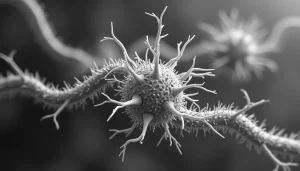
An AI created impression of TRPs on a cell

So far 28 TRPs have been discovered in mammals, each evolving to keep us out of harm’s way—helping us not only stay warm, avoid scalding from cold or heat, but to avoid noxious agents in our environment. These proteins are expressed on the surfaces of cells, much more widely in the body than first thought, even in the brain. They comprise tiny channels into the interior of cells, which are normally closed. Whenever these TRPs get triggered by a specific ‘agonist’, these channels open and allow specific ions to pass into the interior of the respective cell, waking the cell up to transmit further information (often through to the brain where sensations of pain, heat or cold are experienced).
TRPs and chronic pain

Unfortunately, as we age, these sensors can become dysfunctional. A typical manifestation of such dysfunction is a chronic pain condition. In this situation, a specific TRP may be stuck open in a chronically ‘up-regulated’ state, like a switch jammed in the ‘on’ position. TRPs are now known to be implicated in a number of very nasty life-limiting chronic diseases, which is why the pharmaceutical companies are on the case. Biomedicine isn’t good with these sorts of conditions. What Big Pharma hopes to discover is a new drug that can be patented for profit, that can safely tweak these dysfunctions. But to affect the up-regulated TRPs in the brain, they need to get their drug safely through the blood-brain barrier, and this isn’t just very difficult, it’s dangerous.

However, this Big Pharma-funded research has unexpectedly opened up a whole new way to review our humble moxa therapy. It certainly doesn’t discount those other mechanisms (ANS regulation, or HSPs, or indeed qi flow) but it adds a fresh dimension of understanding, which includes explaining why moxa has long been favoured over acupuncture for two things—treating chronic and difficult diseases (including chronic pain) and promoting longevity. Three of these TRPs, which are both temperature sensitive and reactive to chemicals, are often co-expressed on the same cells. This almost certainly means that they evolved together, with everything working optimally when they are fully functional. Unfortunately, it looks like many aspects of today’s chronic diseases (and ageing itself) reflect situations when they don’t work so well together—in fact, when they might even work against each other, maintaining a chronic imbalanced state.

Now, here’s how this new research affects our understanding of moxa in a remarkable way. We are sure that moxa can separately modulate all three of these pain-related TRPs—one of them through heat, and two of them through absorption of chemicals through the skin. These TRPs respond only to two chemicals, which, by extraordinary coincidence, happen to be the two dominant chemicals in mugwort. And although several other materials were mentioned in the classics, we think that this highly improbable interaction with mugwort explains why it emerged as the favoured material for moxibustion. It may also explain why, over 2,000 years ago, moxa got its reputation for treating chronic disease, and why moxa maintained its reputation for promoting longevity, century after century. In both instances, our acumoxa predecessors were merrily tweaking these TRPs in their patients with moxa, without knowing a thing about them! Given what we now know, and what more we can expect to emerge in the coming years, we have an extraordinary opportunity to review our moxibustion techniques. We can look for specific ways of using moxa that might provoke downstream effects through the chain of TRPs between skin and brain. We should strive to keep our techniques as simple as possible, while employing thoughtful strategies, based on this new knowledge, to enhance their effectiveness. We must also make sure they remain unpatentable, so the therapy remains super-cheap and accessible.

What types of conditions could we hope to treat? Up-regulated TRPs cause pain, so down-regulating them with moxa means that chronic pain conditions could respond very well—we’ve already seen exciting results with fibromyalgia. A new approach to moxibustion could potentially also help Parkinson’s Disease, dementia, chronic anxiety states, sickle-cell disease, and even obesity. We have the chance to devise a whole new range of 21st-century point protocols for various conditions, applying moxa to maximise its TRP-regulating effects. And we can do this while trusting to a two-millennia long safety profile, which gives us quite an advantage over Big Pharma—moxa is cheaper, safer and easier to apply!

All of these are discussed in the forthcoming second edition of The Moon over Matsushima. This has been updated with over 40 new pages, which unpick this Big Pharma research and discuss its implications. What’s more, shortly after publication, a new, shorter book The Moon at the Window will follow. Listing moxa treatments for over 300 conditions, this second book will also discuss how we might best approach any difficult modern condition in light of both our ancient and now super-modern understandings. Published by Sayoshi Books, our hope is that these two books will galvanise important discussion and collaborative investigation, both in Japan and the West into this extraordinary therapy that we call moxa.

Unlike any other book on moxibustion, The Moon over Matsushima Second Edition will open your mind to the use of moxa in the past, present, and future. Don’t miss out on these cutting-edge insights. Sign up for more information about the launch and receive exclusive updates by filling out the form below:


TRPs and a New Model for Understanding Moxibustion Read More »