Palpating a Path to the Ear: Ontake Moxibustion for Hearing Loss and Tinnitus
Palpating a Path to the Ear: Ontake Moxibustion for Hearing Loss and Tinnitus
In this post, I’ll describe a palpation-based Ontake routine I use when treating patients with hearing loss and tinnitus. If you make it to the end of this post, there’s a video there that shows the routine in action!
It is not a miracle cure, and it will not help every case. But in selected patients, especially where abnormal tissue findings are present around the neck, scalp, mastoid or ear, I have found it can produce surprisingly rapid changes—much faster than when I used needles alone in my Japanese acupuncture practice.
When I teach, I always use an analogy to explain what we’re doing. When you go to visit your best friend, you ring the doorbell. That sends information from the outside of the house to the inside, triggering movement. We can’t say that the doorbell opened the door. Acupuncture and moxibustion are the same. We send information from the outside of the body that triggers change. We can’t say that the treatment cures the person. Instead, it triggers the body to cure itself.
Over the better part of twenty-five years, I’ve developed a palpation and Ontake routine that helps us shape the information we want to present to the outside of the body, to help trigger those changes in the circulation of qi and blood to the ear. This routine is simple to learn, and readers can adapt it to their own protocols for patients presenting with these problems. Of course, the key is practice: learning to recognise the palpatory indicators and accumulating experience with what they mean. Palpate, treat what you find, then step back and let the body do the rest.
Learning to Read the Body
This approach has its roots in something that happened to me in Tokyo in 2000, at a Toyohari seminar, long before I’d developed Ontake at all (Toyohari is a meridian therapy style of Japanese acupuncture). A model in my study group complained of migraines, and one of our teachers—Akihiro Takai, then president of the Toyohari Association—palpated her scalp and asked her, without being told anything, whether the migraines were on the right: they were. This astounded the rest of us, but he guided our hands to the same spot so we could feel what he’d felt: the scalp was noticeably tighter on the right than the left. That was my initiation into palpation as an objective way of reading the body—not just confirming what a patient tells you, but finding things they haven’t told you at all.
A Finding Nobody Asked For
Maybe six or eight months after that Tokyo seminar, I had a patient—I’ll call him Tom, about thirty at the time—who came in without mentioning that he had headaches. As I was palpating his neck, something we do routinely in Toyohari, I noticed something odd: a puffy, spongy swelling around the right mastoid process. On a hunch, I asked him if he got headaches.
“Yeah,” he said. “I get migraines. On the right.”
At that point in my career, I hadn’t yet encountered Ontake, so I treated the area with a teishin, stroking gently over the abnormal tissue. I repeated this over two or three visits. Each time, the puffiness was less pronounced. By the third visit, it had all but resolved—the tissue felt normal again.
I didn’t see Tom again for years. When I finally did, one of the first things he told me was that he had never had a migraine again. As is so often the way with palpation, it revealed something he hadn’t mentioned and resolved something he hadn’t thought to address.
An Accidental Clue
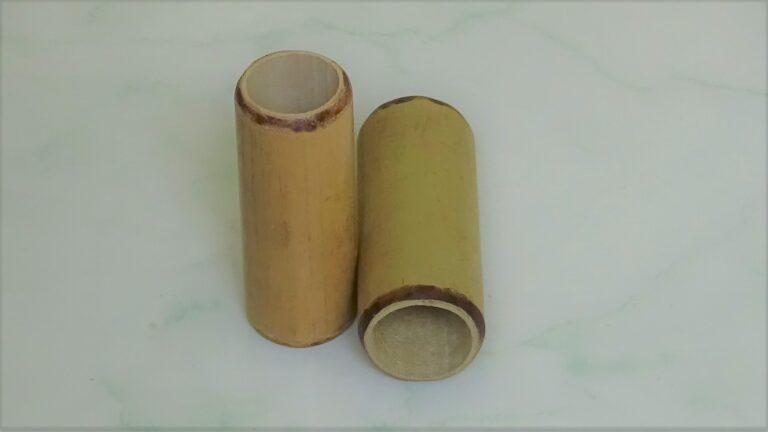
As you might know, I was introduced to Ontake in 2009, and by 2019, I was teaching the Ontake Method in Brazil. The group was practising Bamboo Max—a whole-body Ontake sequence working the arms, legs, and back.
After the session, one student approached me and asked whether Bamboo Max was supposed to cure tinnitus. It isn’t—that’s not what I’d taught it for. But when I asked whether she’d had neck problems, she said yes, and that her neck was also feeling much better.
My guess was that Bamboo Max, by releasing abnormal tissue along the six yang channels—small intestine, triple burner and large intestine in the arms; stomach, gallbladder and bladder in the legs—was indirectly releasing the neck, since all six channels pass through it. And if the neck releases, blood can move more freely into the ears. As you’ll see below, I already had an Ontake routine for ear problems. This was something else: a clue that a whole-body sequence, never designed with the ears in mind, could reach them anyway, by way of the neck.
The Three Circles
A year later, back in Brazil, I was demonstrating the ear routine described in my book Moxa in Motion. It’s two short paragraphs and describes palpating and treating three concentric circles worked at three different frequencies:
- An outer circle roughly following the gallbladder channel’s zigzag across the temple, tapped at 120 beats per minute
- A middle circle following the perimeter of the ear on the scalp, at the triple burner frequency of 152 beats per minute
- An inner circle on the auricle itself, back at the kidney frequency of 120 beats per minute
I asked for a volunteer, found some puffiness in his temple, and worked that side. When I finished, he surprised me by asking me to treat the other side as well.
I assumed he was just enjoying the Ontake—after all, it is very relaxing, but that wasn’t it. He had tinnitus in both ears, and the sounds in his right ear had stopped after the demo. Could I treat the left as well?
In my experience, treating tinnitus with needling can lead to improvement and resolution, but it takes months. An almost instantaneous result was, at that point, only the second time I’d seen anything like it. I treated the left side, and he reported the same: for the first time in a long while, he had no ringing in either ear. I wasn’t able to follow up with him afterwards, so I don’t know what the longer-term outcome was—but in the short term, it was a striking result.
This has been a recurring theme on my teaching tours. Ontake often seems to produce rapid changes with tinnitus. What I hadn’t seen—until this year—was whether it could do the same for hearing loss.
Josh: Hearing Loss Since Childhood
Fortunately, we filmed this demonstration, so you can see in detail how I approached this case. As a child of seven or eight, Josh had what may have been skull-base osteomyelitis (he’s not sure of the diagnosis and described it as “bone-eating disease”). He underwent surgery to remove infected tissue from his occiput and the area behind his ear. In the years since, he’s had hearing loss in both ears, more pronounced on the left.
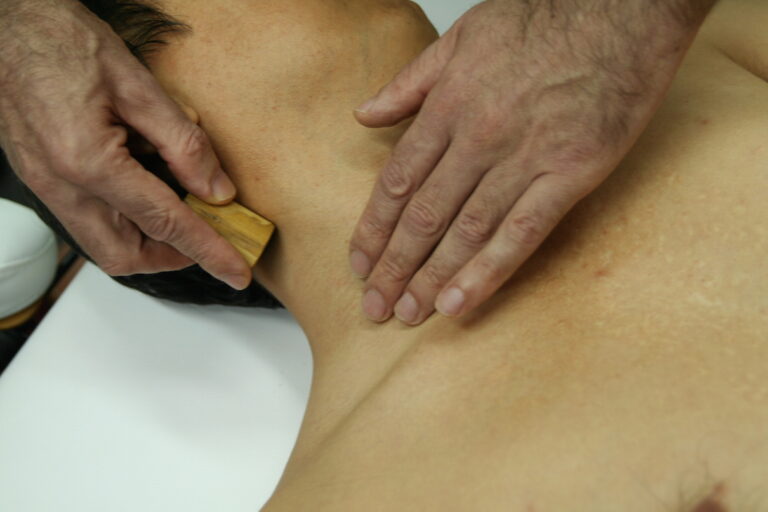
I started by palpating what we call, in Toyohari, the naso region, the front and back of the neck. On the left, it was markedly kyo—deficient, dry, inelastic, as though no qi was moving through it at all. I began treating the healthier right side first, tapping with Ontake and addressing what I found there.
Working up into his scalp, I found abnormal tissue on both sides: a painful area on the right, and—behind both ears—scars that were still active. An active scar, in this context, feels different from a healed one. A healed scar feels essentially two-dimensional under the fingers—flat, with no depth to it. An active scar has depth: a three-dimensional, worm-like quality, as though there’s a thin structure running just beneath the skin. In Josh’s case, each scar was about 1.5cm, flush with the skin surface but extending downward—like a thin horizontal worm beneath the skin.
I think of an active scar as a lock gate across a canal. Qi and blood pool on one side—that side feels excess, or jitsu—while the other side runs low, feeling deficient, or kyo. We need to balance the water levels on either side of the lock. Treating a scar with Ontake means applying draining techniques where there’s excess and supplementing techniques where there’s deficiency, to rebalance qi and blood across it. That’s what I did on both of Josh’s scars.
Interestingly, I was using a metronome, positioned by his left ear, throughout the treatment. By the time I’d finished working on his neck, he told me the metronome had already grown clearer. His left ear normally couldn’t pick up low-volume sounds at all—but as I worked, the metronome’s volume seemed, in his perception, to grow. By the time I had finished both sides, he reported that the hearing in his left ear felt normal. This perceived improvement lasted for a couple of months after the session: he felt he had normal hearing again.
That kind of response speed is not what we expect with long-standing hearing loss. As I say in the video, it’s “impossible!” But it did, making me even more in awe of the power of moxibustion to treat chronic conditions.
Conclusion
I’m not proposing I’ve found a cure for tinnitus or hearing loss with Ontake. What I think I’ve developed is an approach—a palpation and treatment routine—that can be useful in certain cases and that practitioners can adapt for patients presenting with these problems.
As I said at the start, we’re not curing the patient. We’re sending information from outside the body to the inside, the way a doorbell sends a signal from outside a house to whoever’s inside to hear it. We can’t say the doorbell opened the door. We can only say it caused something to happen.
Palpate. Treat what you find. Then step back and let the body do the rest.
Palpating a Path to the Ear: Ontake Moxibustion for Hearing Loss and Tinnitus Read More »